
Spotting the Signs: Stutsman County's Guide to Melanoma Awareness
by Kaitlyn Utke
January 2026
As winter sets in, it's a great time for Stutsman County residents to check their skin for signs of sun damage or unusual spots, some that might be an early skin cancer. Of the several types of skin cancer, melanoma is the type that tends to spread quickly to other body areas and cause death. Up to five Stutsman County residents may develop this cancer this year, according to North Dakota public health information. For them – and for all the county residents – skin cancer prevention and regular skin self-checks could be lifesaving.
Although melanoma can happen to anyone, people who spend a lot of time in the sun, have fair skin, lots of moles, or a family history of skin cancer have more risk. Skin doctors believe that risks are decreased if individuals themselves understand they are their own first line of defense by doing things like protecting their skin with clothing and hats and doing regular skin self-checks to catch any concerning spots early.
Some insurance companies cover yearly skin checks by providers, but suspicious spots can appear between routine check-ups and annual physicals, making self-checks important. One self-check tip is looking for the "Ugly Duckling Sign." Because most moles on the body tend to look alike, if one stands out as looking different – the "ugly duckling" – it may need to be checked by a healthcare provider.
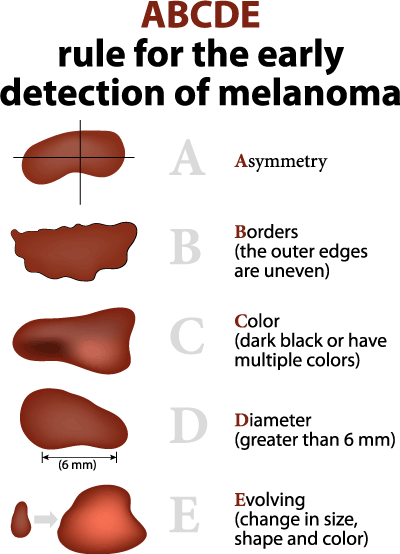 Another guide is the ABCDE rule of melanoma: A stands for
Asymmetry, when one half of a mole
doesn't match the other; B is for
Border, when the edges are irregular or
jagged; C is for Color, when the mole
has more than one shade of brown, black, or even red or
blue; D is for Diameter, when the spot
is larger than a pencil eraser; and E is for
Evolving, when the mole changes over
time. Any of these signs? Don't wait – get them
checked by a healthcare professional.
Another guide is the ABCDE rule of melanoma: A stands for
Asymmetry, when one half of a mole
doesn't match the other; B is for
Border, when the edges are irregular or
jagged; C is for Color, when the mole
has more than one shade of brown, black, or even red or
blue; D is for Diameter, when the spot
is larger than a pencil eraser; and E is for
Evolving, when the mole changes over
time. Any of these signs? Don't wait – get them
checked by a healthcare professional.
Melanoma affects both men and women, but where it commonly shows up can differ by sex. For men, it's the back, chest, or scalp. Self-checking those areas? Using a mirror and maybe another person to look. For women, it's the legs, an easier area for self-check. For both sexes, the face and neck are common areas – 30% of all melanomas show up in those two locations. One surprising place? The lips. Dentists sometimes spot melanoma there as it can mimic a cold sore.
Moving to prevention efforts, a first step is wearing clothing to cover sun-exposed areas. A wide-brimmed hat helps shield neck and ears. Sunscreens offer additional protection, adding extra defense even on cloudy days. More specifics on sunscreens: SPF, or sun protection factor, measures how well a sunscreen protects the skin from the sun's harmful rays – the higher the number, the more protection. Some research has shown melanoma chances can be decreased by 30 to 50%, depending on the SPF strength.
Another prevention tip: Reconsider tanning beds. Thought to provide a tan with less risk of cancer because a sunburn can be avoided, experts have discovered the beds' lights are so intense that tanning beds increase chances of melanoma by nearly 50%.
With efforts like skin protection and regular skin self-checks, melanoma chances can be decreased or discovered early before it spreads through the body. No one understands melanoma better than the person living with it who'd noticed a suspicious spot but delayed seeking medical evaluation. Noticing changes, trusting instincts, and seeking help without delay can make all the difference.
About the Author
 Kaitlyn Utke is a third-year medical student at
the University of North Dakota School of Medicine &
Health Sciences. She was selected as a Jamestown
participant for the school's ROME program, or Rural
Opportunities in Medical Education. Part of the ROME
program teaches student doctors how rural newspapers can
be partners for sharing health information. The
information presented here is not intended for diagnosis
or treatment and should not be used in place of previous
medical advice provided by a licensed provider.
Kaitlyn Utke is a third-year medical student at
the University of North Dakota School of Medicine &
Health Sciences. She was selected as a Jamestown
participant for the school's ROME program, or Rural
Opportunities in Medical Education. Part of the ROME
program teaches student doctors how rural newspapers can
be partners for sharing health information. The
information presented here is not intended for diagnosis
or treatment and should not be used in place of previous
medical advice provided by a licensed provider.